using Agents
using Random
using LinearAlgebra
using Base64
using CairoMakie
CairoMakie.activate!(px_per_unit = 1.0)Flocking model
Continuous-space agent interactions. Source
Each agent follows three simple rules:
- maintain a minimum distance from other birds to avoid collision
- fly towards the average position of neighbors
- fly in the average direction of neighbors
The helper function is adapted from Agents.abmvideo and correctly displays animations in Jupyter notebooks
function abmvio(model;
    dt = 1, framerate = 30, frames = 300, title = "", showstep = true,
    figure = (size = (600, 600),), axis = NamedTuple(),
    recordkwargs = (compression = 23, format ="mp4"), kwargs...
)
    # title and steps
    abmtime_obs = Observable(abmtime(model))
    if title ≠ "" && showstep
        t = lift(x -> title*", time = "*string(x), abmtime_obs)
    elseif showstep
        t = lift(x -> "time = "*string(x), abmtime_obs)
    else
        t = title
    end

    axis = (title = t, titlealign = :left, axis...)
    # First frame
    fig, ax, abmobs = abmplot(model; add_controls = false, warn_deprecation = false, figure, axis, kwargs...)
    resize_to_layout!(fig)
    # Animation
    Makie.Record(fig; framerate, recordkwargs...) do io
        for j in 1:frames-1
            recordframe!(io)
            Agents.step!(abmobs, dt)
            abmtime_obs[] = abmtime(model)
        end
        recordframe!(io)
    end
end
abmvio (generic function with 1 method)This agents has also three properties inherited from ContinuousAgent
- id : unique identifier
- pos : XY coordinate
- vel: XY velocity
@agent struct Bird(ContinuousAgent{2,Float64})
    speed::Float64
    cohere_factor::Float64
    separation::Float64
    separate_factor::Float64
    match_factor::Float64
    visual_distance::Float64
end
Model factory function
function initialize_model(;
    n_birds = 100,
    speed = 1.5,
    cohere_factor = 0.1,
    separation = 2.0,
    separate_factor = 0.25,
    match_factor = 0.04,
    visual_distance = 5.0,
    extent = (100, 100),
    seed = 2024,
)
    space2d = ContinuousSpace(extent; spacing = visual_distance/1.5)
    rng = Random.MersenneTwister(seed)

    model = StandardABM(Bird, space2d; rng, agent_step!, scheduler = Schedulers.Randomly())
    for _ in 1:n_birds
        vel = rand(abmrng(model), SVector{2}) * 2 .- 1
        add_agent!(
            model,
            vel,
            speed,
            cohere_factor,
            separation,
            separate_factor,
            match_factor,
            visual_distance,
        )
    end
    return model
end
initialize_model (generic function with 1 method)Stepping function
function agent_step!(bird, model)
    # Obtain the ids of neighbors within the bird's visual distance
    neighbor_ids = nearby_ids(bird, model, bird.visual_distance)
    N = 0
    match = separate = cohere = (0.0, 0.0)
    # Calculate behaviour properties based on neighbors
    for id in neighbor_ids
        N += 1
        neighbor = model[id].pos
        heading = get_direction(bird.pos, neighbor, model)

        # `cohere` computes the average position of neighboring birds
        cohere = cohere .+ heading
        if euclidean_distance(bird.pos, neighbor, model) < bird.separation
            # `separate` repels the bird away from neighboring birds
            separate = separate .- heading
        end
        # `match` computes the average trajectory of neighboring birds
        match = match .+ model[id].vel
    end

    N = max(N, 1)
    # Normalise results based on model input and neighbor count
    cohere = cohere ./ N .* bird.cohere_factor
    separate = separate ./ N .* bird.separate_factor
    match = match ./ N .* bird.match_factor
    # Compute velocity based on rules defined above
    bird.vel = (bird.vel .+ cohere .+ separate .+ match) ./ 2
    bird.vel = bird.vel ./ norm(bird.vel)
    # Move bird according to new velocity and speed
    move_agent!(bird, model, bird.speed)
end
agent_step! (generic function with 1 method)Visualization
const bird_polygon = Makie.Polygon(Point2f[(-1, -1), (2, 0), (-1, 1)])
function bird_marker(b::Bird)
    φ = atan(b.vel[2], b.vel[1]) ##+ π/2 + π
    rotate_polygon(bird_polygon, φ)
end
bird_marker (generic function with 1 method)model = initialize_model()
figure, _ = abmplot(model; agent_marker = bird_marker)
figure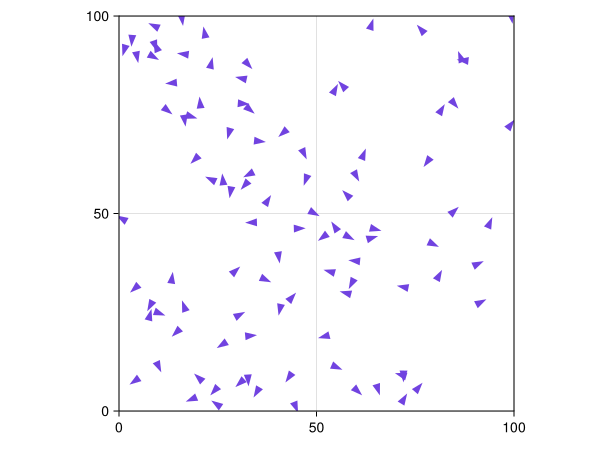
Animation
vio = abmvio(
    model;
    agent_marker = bird_marker,
    framerate = 20, frames = 150,
    title = "Flocking",
)
save("flocking.mp4", vio)
vio |> display
This notebook was generated using Literate.jl.