This continuous space model assumes people as circles bumping each other to simulate infection process. Source: Agents.jl model zoo
using Agents
using Random
using Base64
using CairoMakie
CairoMakie.activate!(px_per_unit = 1.0)
The helper function displays video files in Jupyter notebooks
function display_mp4(filename)
    display("text/html", string("""<video autoplay controls><source src="data:video/x-m4v;base64,""",
        base64encode(open(read, filename)),
        """" type="video/mp4"></video>"""))
end
display_mp4 (generic function with 1 method)Let us first create a simple model where balls move around in a continuous space. We need to create agents that comply with ContinuousSpace, i.e. they have a pos and vel fields, both of which are tuples of float numbers.
@agent struct SocialAgent(ContinuousAgent{2, Float64})
    mass::Float64
end
Ball collision model
function ball_model(; speed=0.002, seed=42, model_step! = (m)->nothing)
    space2d = ContinuousSpace((1, 1); spacing = 0.02)
    rng = MersenneTwister(seed)
    model = StandardABM(SocialAgent, space2d; agent_step!, model_step!, properties = Dict(:dt => 1.0), rng)

    for i in 1:500
        pos = Tuple(rand(rng, 2))
        vel = sincos(2π * rand(rng)) .* speed
        mass = 1.0
        add_agent!(pos, model, vel, mass)
    end
    return model
end
ball_model (generic function with 1 method)Move the agent in a continuous space
agent_step!(agent, model) = move_agent!(agent, model, model.dt)agent_step! (generic function with 1 method)Visualization (I)
vio = abmvideo("social1.mp4", ball_model();
    title="Ball Model", agent_size=10,
    frames=100, dt=2, framerate=25,
)

display_mp4("social1.mp4")As you can see the agents move in a straight line in a periodic space without interactions. Let’s change that.
Billiard-like interaction
We can simulate agent collisions using the API:
interacting_pairs(m, radius, method)elastic_collision!(a1, a2, :mass)
And we redefine the model stepping function with elastic collision:
function model_step!(model)
    for (a1, a2) in interacting_pairs(model, 0.010, :nearest)
        elastic_collision!(a1, a2, :mass)
    end
end

abmvideo(
    "social2.mp4",
    ball_model(;model_step!);
    title="Billiard-like", agent_size=10,
    frames=100, dt=2, framerate=25,
)

display_mp4("social2.mp4")Immovable agents
For the following social distancing example, it will become crucial that some agents don’t move, and can’t be moved (i.e. they stay “isolated”). This is very easy to do with the elastic_collision! function, we only have to make some agents have infinite mass.
model3 = ball_model(;model_step!)

for i in 1:400
    agent = model3[i]
    agent.mass = Inf
    agent.vel = (0.0, 0.0)
end

abmvideo(
    "social3.mp4", model3;
    title="Billiard-like with stationary agents",
    agent_size=10,
    frames=100, dt=2, framerate=25,
)

display_mp4("social3.mp4")Virus spread (SIR model)
The agents can be infected with a disease and transfer the disease to other agents around them.
@agent struct SIRAgent(ContinuousAgent{2, Float64})
    mass::Float64       ## Movable or not
    days_infected::Int  ## number of days since is infected
    status::Symbol      ## :S, :I or :R
    β::Float64          ## Transmission rate
end

const steps_per_day = 24

function sir_initiation(;
    infection_period = 30 * steps_per_day,
    detection_time = 14 * steps_per_day,
    reinfection_probability = 0.05,
    isolated = 0.0, ## in percentage
    interaction_radius = 0.012,
    dt = 1.0,
    speed = 0.002,
    death_rate = 0.044,
    N = 1000,
    initial_infected = 5,
    seed = 42,
    βmin = 0.4,
    βmax = 0.8,
)

    properties = (;
        infection_period,
        reinfection_probability,
        detection_time,
        death_rate,
        interaction_radius,
        dt,
    )
    space = ContinuousSpace((1,1); spacing = 0.02)
    model = StandardABM(SIRAgent, space, agent_step! = sir_agent_step!,
                        model_step! = sir_model_step!, properties = properties,
                        rng = MersenneTwister(seed))

    # Add initial individuals
    for ind in 1:N
        pos = Tuple(rand(abmrng(model), 2))
        status = ind ≤ N - initial_infected ? :S : :I
        isisolated = ind ≤ isolated * N
        mass = isisolated ? Inf : 1.0
        vel = isisolated ? (0.0, 0.0) : sincos(2π * rand(abmrng(model))) .* speed

        β = (βmax - βmin) * rand(abmrng(model)) + βmin
        add_agent!(pos, model, vel, mass, 0, status, β)
    end

    return model
end
sir_initiation (generic function with 1 method)Stepping functions
function transmit!(a1, a2, reinfectprob, model)
    # for transmission, only 1 can have the disease (otherwise nothing happens)
    count(a.status == :I for a in (a1, a2)) ≠ 1 && return nothing
    infected, healthy = a1.status == :I ? (a1, a2) : (a2, a1)
    rng = abmrng(model)

    rand(rng) > infected.β && return nothing

    if healthy.status == :R
        rand(rng) > reinfectprob && return nothing
    end
    healthy.status = :I
    return nothing
end

function recover_or_die!(agent, model)
    if agent.days_infected ≥ model.infection_period
        if rand(abmrng(model)) ≤ model.death_rate
            remove_agent!(agent, model)
        else
            agent.status = :R
            agent.days_infected = 0
        end
    end
    return nothing
end

function sir_model_step!(model)
    r = model.interaction_radius
    for (a1, a2) in interacting_pairs(model, r, :nearest)
        transmit!(a1, a2, model.reinfection_probability, model)
        elastic_collision!(a1, a2, :mass)
    end
    return nothing
end

update!(agent) = agent.status == :I && (agent.days_infected += 1)

function sir_agent_step!(agent, model)
    move_agent!(agent, model, model.dt)
    update!(agent)
    recover_or_die!(agent, model)
end
sir_agent_step! (generic function with 1 method)Visualize the initial condition
sir_model = sir_initiation()StandardABM with 1000 agents of type SIRAgent
agents container: Dict
space: periodic continuous space with [1.0, 1.0] extent and spacing=0.02
scheduler: fastest
properties: infection_period, reinfection_probability, detection_time, death_rate, interaction_radius, dtS = black; I = red; R = green
sir_colors(a) = a.status == :S ? "#2b2b33" : a.status == :I ? "#bf2642" : "#338c54"sir_colors (generic function with 1 method)Plot figure
fig, ax, abmp = abmplot(sir_model; agent_color = sir_colors, agent_size = 10)
fig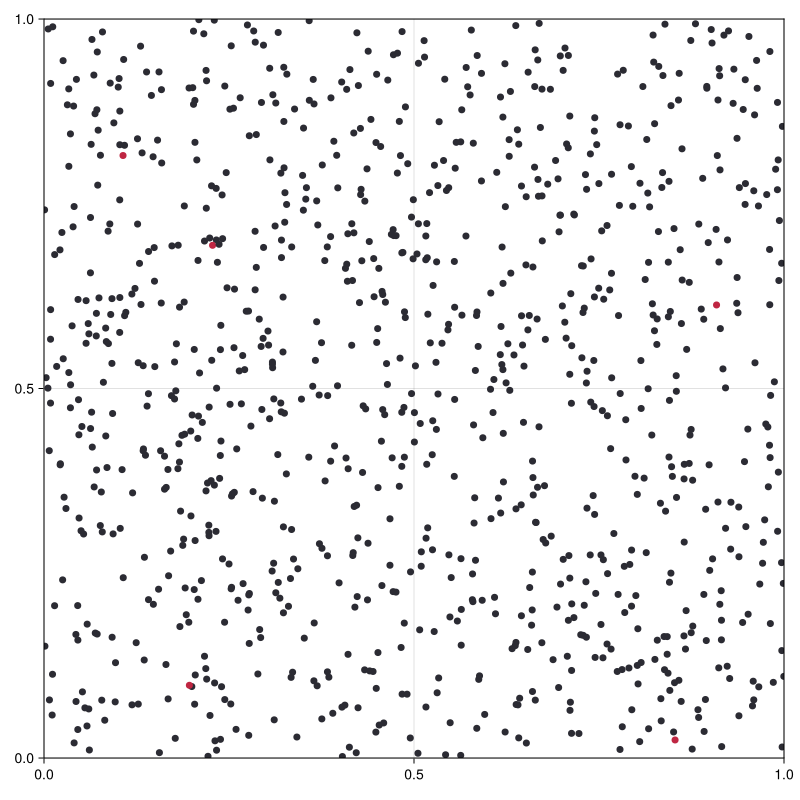
Animation time
sir_model = sir_initiation()

abmvideo(
    "social4.mp4",
    sir_model;
    title = "SIR model",
    frames = 80,
    agent_color = sir_colors,
    agent_size = 10,
    dt = 1,
    framerate = 20,
)

display_mp4("social4.mp4")Analyzing exponential spread
infected(x) = count(i == :I for i in x)
recovered(x) = count(i == :R for i in x)
adata = [(:status, infected), (:status, recovered)]
2-element Vector{Tuple{Symbol, Function}}:
(:status, Main.var"##277".infected)
(:status, Main.var"##277".recovered)Try different parameters
r1, r2 = 0.02, 0.05
β1, β2 = 0.5, 0.1
sir_model1 = sir_initiation(reinfection_probability=r1, βmax=β1)
sir_model2 = sir_initiation(reinfection_probability=r2, βmax=β1)
sir_model3 = sir_initiation(reinfection_probability=r1, βmax=β2)

data1, _ = run!(sir_model1, 3000; adata)
data2, _ = run!(sir_model2, 3000; adata)
data3, _ = run!(sir_model3, 3000; adata)

data1[(end-10):end, :]figure = Figure()
ax = figure[1, 1] = Axis(figure; ylabel = "Infected")
l1 = lines!(ax, data1[:, dataname((:status, infected))], color = :orange)
l2 = lines!(ax, data2[:, dataname((:status, infected))], color = :blue)
l3 = lines!(ax, data3[:, dataname((:status, infected))], color = :green)
figure[1, 2][1,1] = Legend(figure, [l1, l2, l3], ["r=$r1, beta=$β1", "r=$r2, beta=$β1", "r=$r1, beta=$β2"])
figure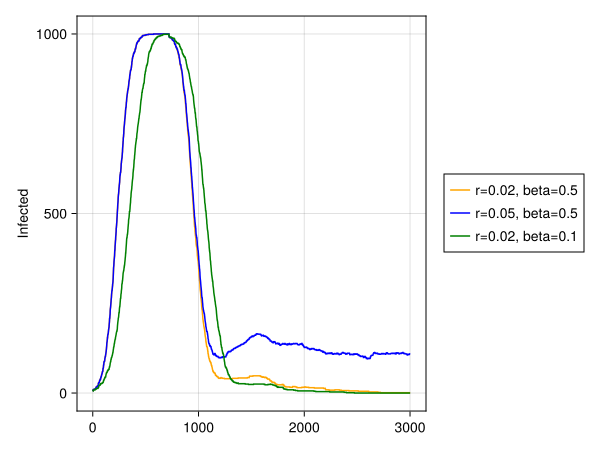
Social distancing
The simplest way to model social distancing is to make some agents stationary. Here we make 80% of the agents not move.
sir_model = sir_initiation(isolated=0.80)

vio = abmvideo(
    "social5.mp4",
    sir_model;
    title="Social Distancing",
    frames=200,
    dt=2,
    agent_color=sir_colors,
    agent_size = 10,
    framerate=20,
)

display_mp4("social5.mp4")Compare the number of infected agents for different parameters.
r4 = 0.02
sir_model4 = sir_initiation(reinfection_probability=r4, βmax=β1, isolated=0.80)

data4, _ = run!(sir_model4, 3000; adata)

figure = Figure()
ax = figure[1, 1] = Axis(figure; ylabel="Infected", xlabel="Steps")
l1 = lines!(ax, data1[:, dataname((:status, infected))], color=:orange)
l2 = lines!(ax, data2[:, dataname((:status, infected))], color=:blue)
l3 = lines!(ax, data3[:, dataname((:status, infected))], color=:green)
l4 = lines!(ax, data4[:, dataname((:status, infected))], color=:red)
figure[1, 2] = Legend(
    figure,
    [l1, l2, l3, l4],
    ["r=$r1, beta=$β1", "r=$r2, beta=$β1", "r=$r1, beta=$β2", "r=$r4, social distancing"],
)
figure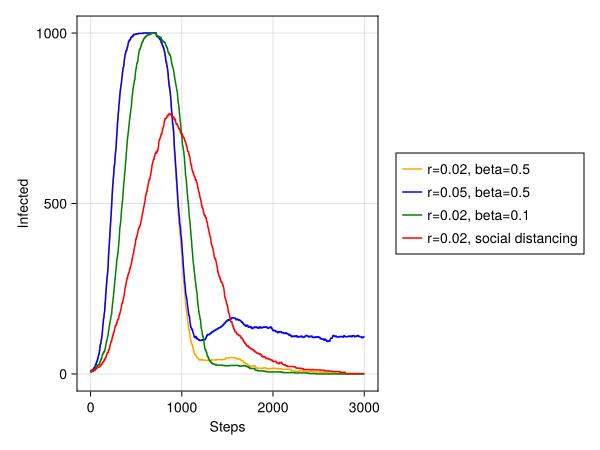
This notebook was generated using Literate.jl.