Fig 2.04
Exponential decay
using Plots
Plots.default(linewidth=1.5)
pl = plot(xlabel="Time", ylabel="Concentration", title="Fig 2.4")
for k in 1:3
plot!(pl, t -> 3 * exp(-k * t), 0, 5, label="exp(-$(k)t)")
end
pl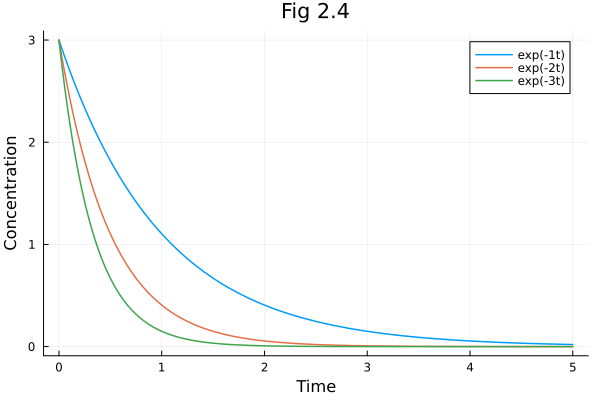
Fig 2.09
Metabolic network simulation
using OrdinaryDiffEq
using Catalyst
using Plots
@time "Build system" rn209 = @reaction_network model209 begin
k1, 0 --> A
k2, A --> B
k3, A + B --> C + D
k4, C --> 0
k5, D --> 0
endBuild system: 15.179578 seconds (29.23 M allocations: 1.607 GiB, 4.51% gc time, 99.92% compilation time: <1% of which was recompilation)
Loading...
up209 = (:k1 => 3.0, :k2 => 2.0, :k3 => 2.5, :k4 => 3.0, :k5 => 4.0, :A => 0.0, :B => 0.0, :C => 0.0, :D => 0.0)
tend = 10.0
@time "Build problem" prob209 = ODEProblem(rn209, up209, tend)
@time "Solve problem" sol = solve(prob209, Tsit5())
plot(sol, title="Fig 2.9", xlabel="Time", ylabel="Concentration")
Build problem: 51.580348 seconds (52.14 M allocations: 2.903 GiB, 2.46% gc time, 99.93% compilation time: 59% of which was recompilation)
Solve problem: 4.767445 seconds (10.55 M allocations: 588.479 MiB, 3.18% gc time, 99.90% compilation time)
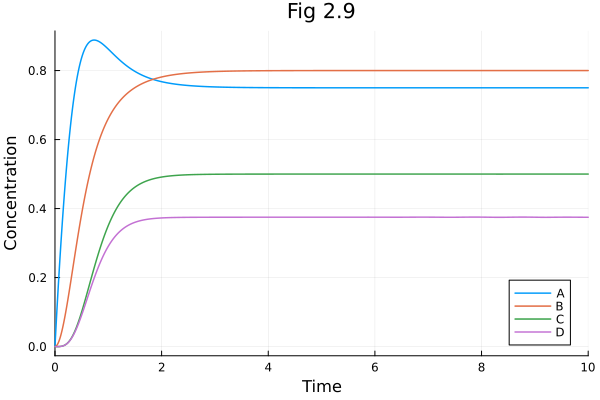
Figure 2.11
Intro to model reduction of ODE metabolic networks.
using OrdinaryDiffEq
using Catalyst
using Plots
@time "Build system" rn211 = @reaction_network model211 begin
k0, 0 --> A
(k1, km1), A <--> B
k2, B --> 0
endBuild system: 0.000548 seconds (1.21 k allocations: 46.633 KiB)
Loading...
up211 = (:k0 => 0.0, :k1 => 9.0, :km1 => 12.0, :k2 => 2.0, :A => 0.0, :B => 10.0)
tend = 3.0
@time "Build problem" prob211 = ODEProblem(rn211, up211, tend)
@time "Solve problem" sol211 = solve(prob211, Tsit5())
plot(sol211, title="Fig 2.11", xlabel="Time", ylabel="Concentration")
Build problem: 1.105892 seconds (1.93 M allocations: 110.081 MiB, 4.90% gc time, 98.22% compilation time: <1% of which was recompilation)
Solve problem: 0.645709 seconds (889.61 k allocations: 49.069 MiB, 99.47% compilation time)
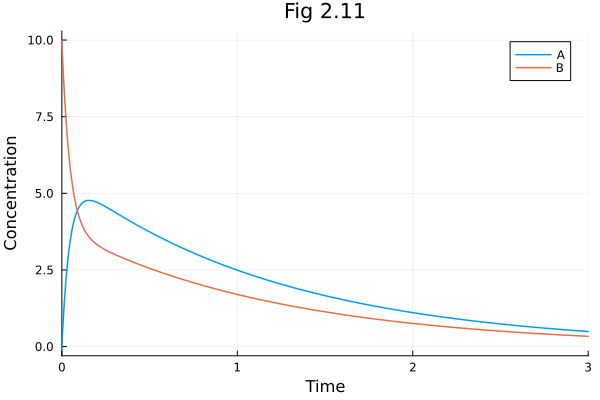
Figure 2.12
Rapid equilibrium assumption
@time "Build system" rn212 = @reaction_network model212 begin
    @parameters k0 k1 km1 k2
    @equations begin
        A ~ C * km1 / (km1 + k1)
        B ~ C * k1 / (km1 + k1)
    end
    k0, 0 --> C
    k2 * k1 / (km1 + k1), C --> 0
end
Build system: 0.519217 seconds (766.23 k allocations: 43.225 MiB, 99.62% compilation time: 34% of which was recompilation)
Loading...
tend = 3.0
up212 = (:k0 => 0.0, :k1 => 9.0, :km1 => 12.0, :k2 => 2.0, :C => 10.0)
@time "Build problem" prob212 = ODEProblem(rn212, up212, tend; mtkcompile=true)
@time "Solve problem" sol212 = solve(prob212, Tsit5())

plot(sol211, linestyle=:dash, label=["A (Full model)" "B (Full model)"])
plot!(sol212, idxs=[:A, :B], linestyle=:solid, label=["A (Reduced model)" "B (Reduced model)"])
plot!(title="Fig 2.12", xlabel="Time", ylabel="Concentration")
Build problem: 1.673280 seconds (2.03 M allocations: 117.476 MiB, 3.67% gc time, 99.42% compilation time: 45% of which was recompilation)
Solve problem: 0.543222 seconds (757.91 k allocations: 41.664 MiB, 99.77% compilation time)
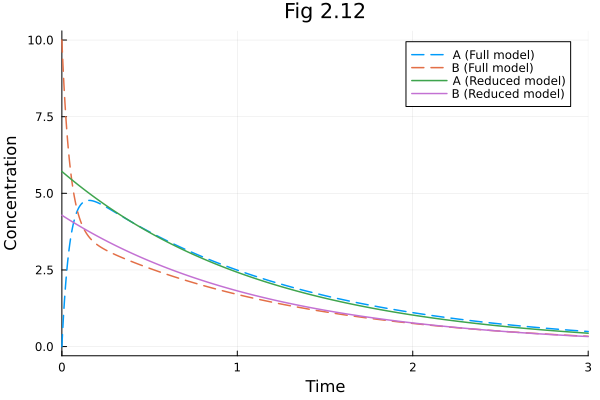
Figure 2.13
When another set of parameters breaks rapid equilibrium assumption.
pmap213 = Dict(:k0=>9.0, :k1=>21.0, :km1=>12.0, :k2=>2.0)
u0map213 = Dict(:A=>8.0, :B=>4.0)
tend = 3.0
prob213full = remake(prob211; p=pmap213, u0=u0map213, tspan=(0.0, tend))
prob213re = ODEProblem(rn212, (:C=>12.0), tend, pmap213; mtkcompile=true)
@time sol213full = solve(prob213full, Tsit5())
@time sol213re = solve(prob213re, Tsit5())

plot(sol213full,  linestyle=:dash, label=["A (Full model)" "B (Full model)"])
plot!(sol213re, idxs=[:A, :B], linestyle=:solid, label=["A (Reduced model)" "B (Reduced model)"])
plot!(title="Fig 2.13", xlabel="Time", ylabel="Concentration")
0.000514 seconds (1.27 k allocations: 63.023 KiB)
0.000297 seconds (620 allocations: 38.820 KiB)
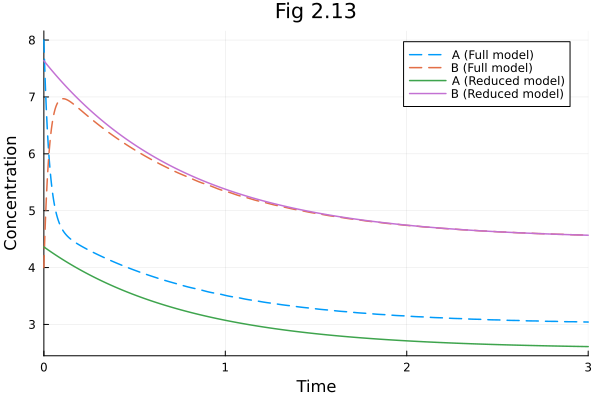
Figure 2.14
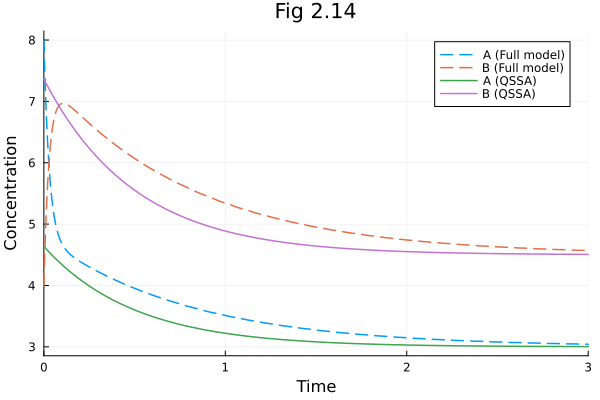
Quasi-steady state assumption on species A (D(A) ~ 0). You can model this in Catalyst.jl DSL like:
@time "Build system" rn214 = @reaction_network model214 begin
    @parameters k0=9 k1=21 km1=12 k2=2
    @variables A(t)
    @equations begin
        A ~ (k0 + km1 * B) / k1
    end
    (k1 * A, (k2 + km1)), 0 <--> B
end
Build system: 0.079404 seconds (72.52 k allocations: 4.030 MiB, 98.41% compilation time)
Loading...
Or use ModelingToolkit.jl equations to set dA ~ 0 directly. The QSS concentrations of A
using ModelingToolkit

function model214(u0; name=:model214)
    @independent_variables t
    @parameters k0=9 k1=21 km1=12 k2=2

    D = Differential(t)
    @variables A(t) B(t) = (k1 * u0 - k0) / (km1 + k1)

    v0 = k0
    v1 = k1 * A - km1 * B
    v2 = k2 * B
    dA = v0 - v1
    dB = v1 - v2

    eqs = [
        0 ~ dA, ## Quasi-steady state assumption on species A (`D(A) ~ 0`)
        D(B) ~ dB,
    ]
    return ODESystem(eqs, t; name)
end

tend = 3.0
@time "Build system" @mtkcompile sys214 = model214(12.0)
@time "Build problem" prob214 = ODEProblem(sys214, [], (0.0, tend))
Build system: 23.090560 seconds (22.45 M allocations: 1.253 GiB, 2.96% gc time, 99.96% compilation time: 88% of which was recompilation)
Build problem: 7.867242 seconds (13.97 M allocations: 804.469 MiB, 2.42% gc time, 99.69% compilation time: 66% of which was recompilation)
ODEProblem with uType Vector{Float64} and tType Float64. In-place: true
Initialization status: FULLY_DETERMINED
Non-trivial mass matrix: false
timespan: (0.0, 3.0)
u0: 1-element Vector{Float64}:
7.363636363636363equations(sys214)Loading...
observed(sys214)Loading...
@time "Solve problem" sol214 = solve(prob214, Tsit5())
@unpack A, B = sys214

plot(sol213full, linestyle=:dash, label=["A (Full model)" "B (Full model)"])
plot!(sol214, idxs=[A, B], linestyle=:solid, label=["A (QSSA)" "B (QSSA)"])
plot!(title="Fig 2.14", xlabel="Time", ylabel="Concentration")
Solve problem: 0.703999 seconds (1.18 M allocations: 67.093 MiB, 99.47% compilation time)
Problem 2.4.6
using OrdinaryDiffEq
using Plots

sol246 = ODEProblem((u, p, t) -> p * (1.0 - u), 0.0, 10.0, 1.0) |> solve
plot(sol246, title="Problem 2.4.6", xlabel="Time", ylabel="Concentration")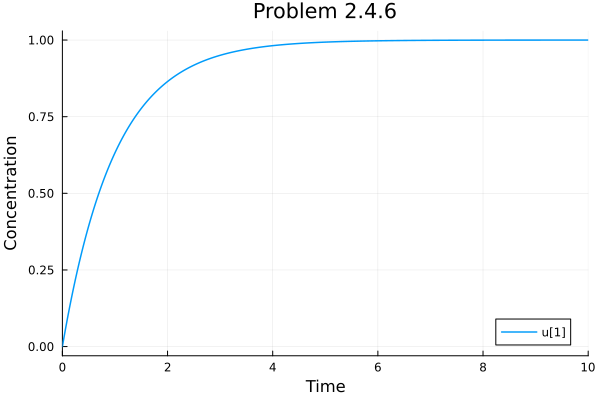
This notebook was generated using Literate.jl.