Standard procedures
Define a model function representing the right-hand-side (RHS) of the system.
Out-of-place form:
f(u, p, t)whereuis the state variable(s),pis the parameter(s), andtis the independent variable (usually time). The output is the right hand side (RHS) of the differential equation system.In-place form:
f!(du, u, p, t), where the output is saved todu. The rest is the same as the out of place form. The in-place form has potential performance benefits since it allocates less than the out-of-place (f(u, p, t)) counterpart.Using ModelingToolkit.jl : define equations and build an ODE system.
Initial conditions (
u0) for the state variable(s).(Optional) define parameter(s)
p.Define a problem (e.g.
ODEProblem) using the modeling function (f), initial conditions (u0), simulation time span (tspan == (tstart, tend)), and parameter(s)p.Solve the problem by calling
solve(prob).
Solve ODEs using OrdinaryDiffEq.jl
Documentation: https://
Single variable: Exponential decay model
The concentration of a decaying nuclear isotope could be described as an exponential decay:
State variable
: The concentration of a decaying nuclear isotope.
Parameter
: The rate constant of decay. The half-life
using OrdinaryDiffEq
using CairoMakie
The model function is the 3-argument out-of-place form, f(u, p, t).
decay(u, p, t) = p * u

p = -1.0            ## Rate of exponential decay
u0 = 1.0            ## Initial condition
tspan = (0.0, 2.0)  ## Start time and end time

prob = ODEProblem(decay, u0, tspan, p)
sol = solve(prob)
retcode: Success
Interpolation: 3rd order Hermite
t: 8-element Vector{Float64}:
0.0
0.10001999200479662
0.34208427066999536
0.6553980136343391
1.0312652525315806
1.4709405856363595
1.9659576669700232
2.0
u: 8-element Vector{Float64}:
1.0
0.9048193287657775
0.7102883621328676
0.5192354400036404
0.35655576576996556
0.2297097907863828
0.14002247272452764
0.1353360028400881Solution at time t=1.0 (with interpolation)
sol(1.0)0.3678796381978344Time points
sol.t8-element Vector{Float64}:
0.0
0.10001999200479662
0.34208427066999536
0.6553980136343391
1.0312652525315806
1.4709405856363595
1.9659576669700232
2.0Solutions at corresponding time points
sol.u8-element Vector{Float64}:
1.0
0.9048193287657775
0.7102883621328676
0.5192354400036404
0.35655576576996556
0.2297097907863828
0.14002247272452764
0.1353360028400881Visualize the solution
fig = Figure()
ax = Axis(fig[1, 1],
    xlabel = "Time",
    ylabel = "Concentration",
    title = "Exponential Decay"
)
lines!(ax, sol, label = "C(t)")
axislegend(ax, position = :rt)
fig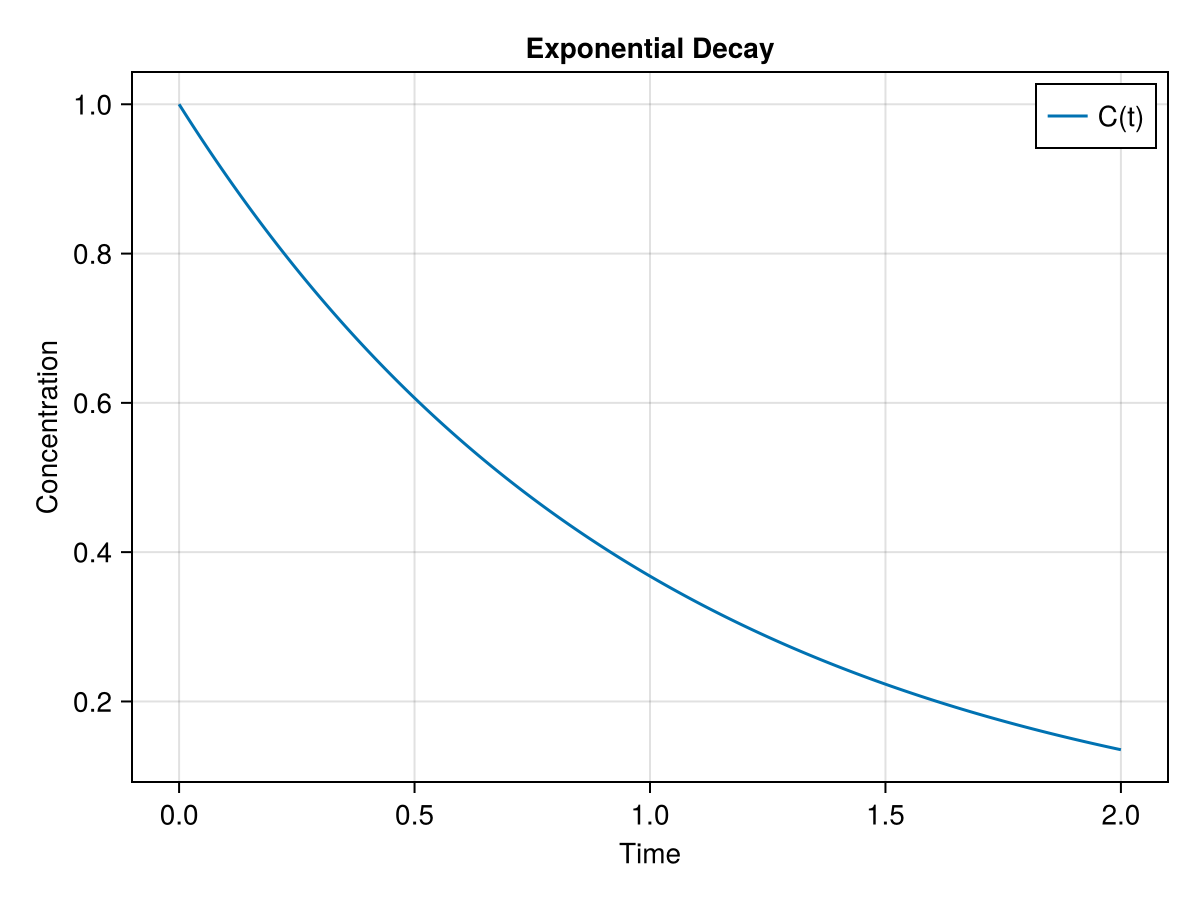
Three variables: The SIR model
The SIR model describes the spreading of an contagious disease can be described by the SIR model:
State variables
: the fraction of susceptible people
: the fraction of infectious people
: the fraction of recovered (or removed) people
Parameters
: the rate of infection when susceptible and infectious people meet
: the rate of recovery of infectious people
using OrdinaryDiffEq
using CairoMakie
SIR model (in-place form can save array allocations and thus faster)
function sir!(du, u, p, t)
    s, i, r = u
    β, γ = p
    v1 = β * s * i
    v2 = γ * i
    du[1] = -v1
    du[2] = v1 - v2
    du[3] = v2
    return nothing
end
sir! (generic function with 1 method)p = (β=1.0, γ=0.3)
u0 = [0.99, 0.01, 0.00]
tspan = (0.0, 20.0)
prob = ODEProblem(sir!, u0, tspan, p)
sol = solve(prob)retcode: Success
Interpolation: 3rd order Hermite
t: 17-element Vector{Float64}:
0.0
0.08921318693905476
0.3702862715172094
0.7984257132319627
1.3237271485666187
1.991841832691831
2.7923706947355837
3.754781614278828
4.901904318934307
6.260476636498209
7.7648912410433075
9.39040980993922
11.483861023017885
13.372369854616487
15.961357172044833
18.681426667664056
20.0
u: 17-element Vector{Vector{Float64}}:
[0.99, 0.01, 0.0]
[0.9890894703413342, 0.010634484617786016, 0.00027604504087978485]
[0.9858331594901347, 0.012901496825852227, 0.0012653436840130785]
[0.9795270529591532, 0.017282420996456258, 0.003190526044390597]
[0.9689082167415561, 0.02463126703444545, 0.006460516223998508]
[0.9490552312363142, 0.03827338797605378, 0.012671380787632141]
[0.9118629475333939, 0.06347250098224964, 0.024664551484356558]
[0.8398871089274511, 0.11078176031568547, 0.049331130756863524]
[0.7075842068024722, 0.19166147882272844, 0.1007543143747994]
[0.508146028721987, 0.29177419341470584, 0.20007977786330722]
[0.31213222024413995, 0.3415879120018046, 0.34627986775405545]
[0.18215683096365565, 0.3099983134156389, 0.5078448556207055]
[0.10427205468919205, 0.22061114011133276, 0.6751168051994751]
[0.07386737407725845, 0.14760143051851143, 0.7785311954042301]
[0.05545028910907714, 0.07997076922865315, 0.8645789416622697]
[0.047334990695892025, 0.04060565321383335, 0.9120593560902746]
[0.04522885458929332, 0.029057416110814603, 0.925713729299892]Visualize the solution
fig = Figure()
ax = Axis(fig[1, 1])
lines!(ax, 0..20, t-> sol(t)[1], label="S")
lines!(ax, 0..20, t-> sol(t)[2], label="I")
lines!(ax, 0..20, t-> sol(t)[3], label="R")
axislegend(ax, position = :rc)
fig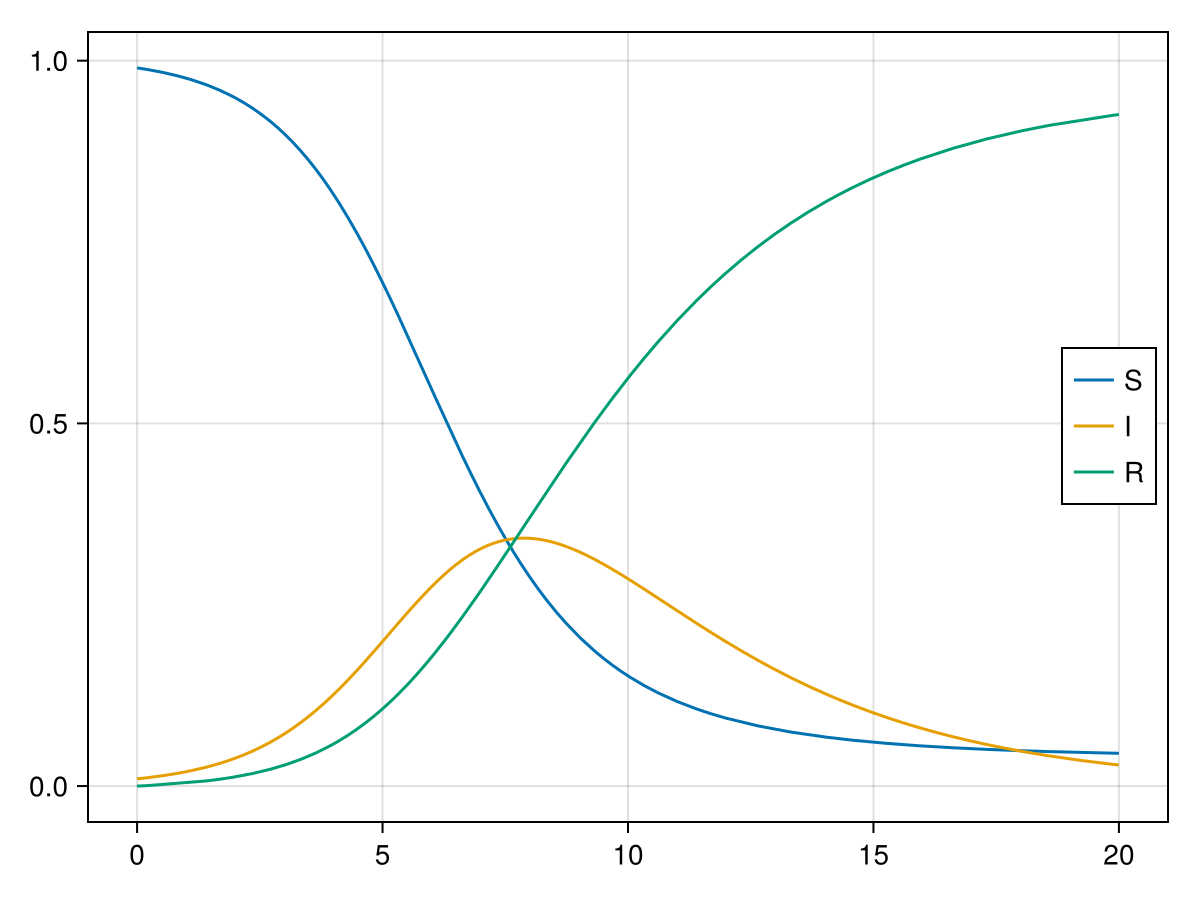
Saving simulation results
using DataFrames
using CSV

df = DataFrame(sol)
CSV.write("sir.csv", df)
rm("sir.csv")
This notebook was generated using Literate.jl.